
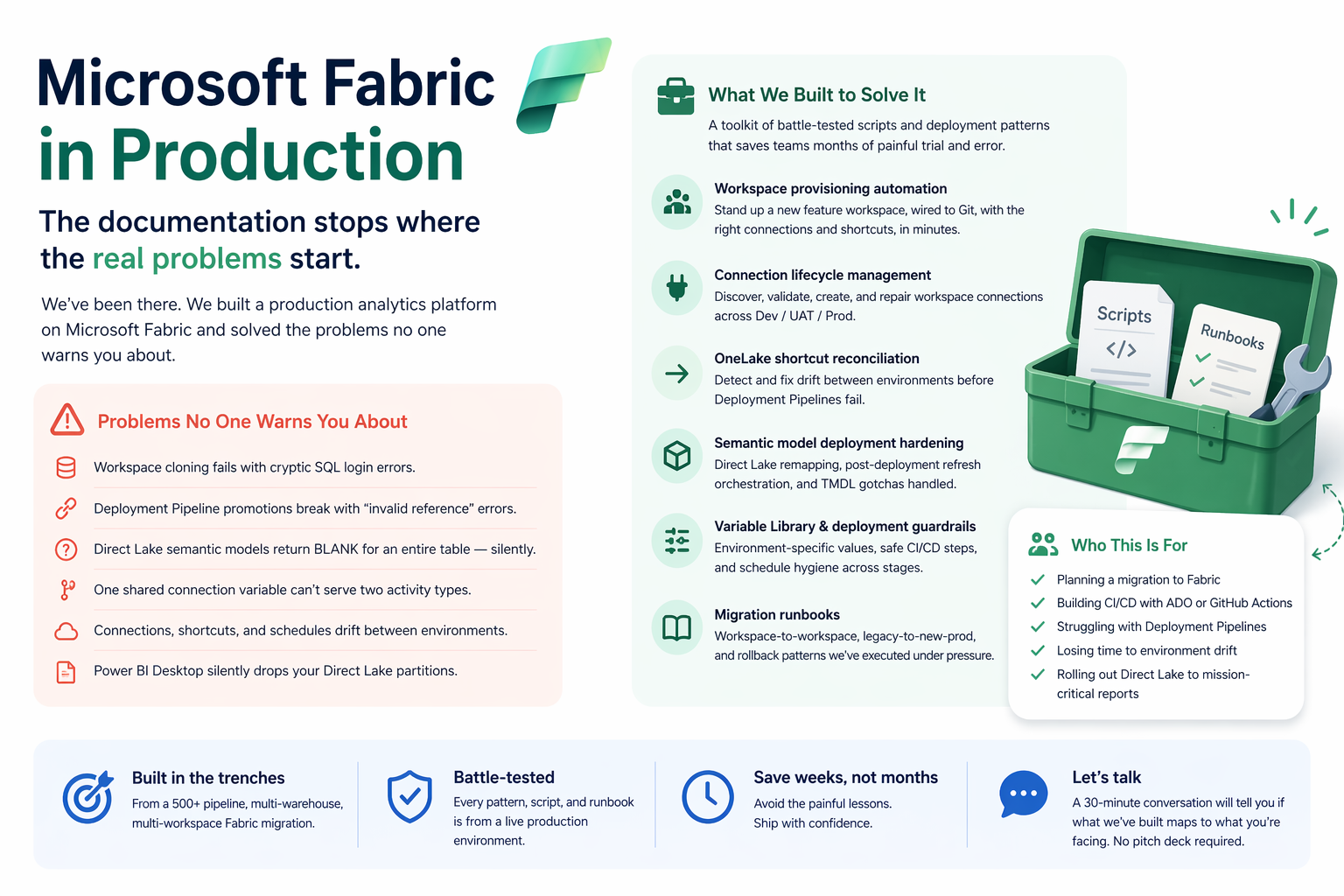
Microsoft Fabric is powerful — and if you're being honest, it can be brutal to operationalize. The documentation stops where the real problems start. We know, because we've built a production analytics platform on Fabric and lived through every undocumented edge case you're about to hit.
The Problems No One Warns You About
If your team is standing up Microsoft Fabric for the first time — or trying to graduate a proof-of-concept into something you'd actually stake a production release on — there's a gap between what the documentation covers and what the platform actually demands. Here's what that gap looks like in practice:
- Workspace cloning fails with cryptic SQL login errors. Stand up a feature workspace and Git sync silently chokes on auto-generated warehouse metadata files. The portal gives you nothing useful to debug it.
- Deployment Pipeline promotions break with "invalid reference" errors. A pipeline works in Dev, fails in UAT, and the GUID in the error message doesn't match anything you recognize. The first time you find the fix, it costs you three hours.
- Direct Lake semantic models return BLANK for an entire table — silently. No error. No warning. A column type drifted between the warehouse and the TMDL, framing failed, and your report just quietly stopped working.
- One shared connection variable can't serve two activity types. SQL Server Lookups and Lakehouse writes need different connection GUIDs, but Fabric's Variable Library expects a single value. Production breaks the moment you migrate workspaces.
- Connections, shortcuts, and schedules drift between environments. Every time someone touches the portal, something drifts. You find out during the next release — not before.
- Power BI Desktop silently drops your Direct Lake partitions. Your Git client normalized line endings. Nothing in the UI tells you why your partitions are gone.
These aren't hypothetical scenarios. Every one of them is something we've encountered and solved in a live production environment.
"The documentation stops where the real problems start."
What We Built to Solve It
Over the course of migrating a 500+ pipeline, multi-warehouse, multi-workspace analytics platform onto Fabric, we developed a toolkit of battle-tested scripts and deployment patterns — the kind of institutional knowledge that typically takes a team three to six months of painful iteration to accumulate.
What's in the toolkit
- Workspace provisioning automation — Stand up a new feature workspace, wired to Git, with the right connections and shortcuts, in minutes instead of days.
- Connection lifecycle management — Discover, validate, create, and repair workspace connections across Dev / UAT / Prod without portal-clicking your way through it.
- OneLake shortcut reconciliation — Detect and fix drift between environments before Deployment Pipelines fail on conflicts.
- Semantic model deployment hardening — Direct Lake remapping, post-deployment refresh orchestration, TMDL parser gotchas documented and handled.
- Variable Library and deployment guardrails — Environment-specific value sets, safe CI/CD post-deployment steps, and schedule hygiene across stages.
- Migration runbooks — Workspace-to-workspace, legacy-to-new-prod, and rollback patterns we've actually executed under pressure.
Who This Is For
If any of the following describes your team's current situation, you're likely a few weeks away from the same lessons we already learned the hard way:
- Planning a migration from Azure Data Factory or Synapse to Fabric
- Building CI/CD for Fabric + Power BI with ADO or GitHub Actions
- Struggling to make Fabric Deployment Pipelines deterministic and reliable
- Losing days per sprint to environment drift and broken promotions
- About to roll Direct Lake into reports your users actually depend on
If that list looks familiar, you're not facing an unusual problem — you're facing the normal Fabric adoption curve. The question is whether you want to spend three months discovering all of this yourself, or compress that learning cycle significantly.
The Bottom Line
We work with data teams who need Fabric to be production-grade, not a science project. We're not selling a product — we're a team that has done this migration before and built the scaffolding to make the next one dramatically less painful.
A 30-minute conversation will tell you quickly whether what we've built maps to what you're facing. No pitch deck required.




Schedule a 30 Minute Assessment
We'll follow up within 1 business day to understand your goals and see where
we can help -- no sales pressure.